
Birmingham City University’s Centre for Human Rights has signed an agreement with the Geneva Human Rights Hub to design and deliver professional training on the United Nations human rights system. It adds to the Centre’s growing international profile and opens a new route for the university’s doctoral researchers.
Birmingham City University (BCU) has signed a Memorandum of Understanding with the Geneva Human Rights Hub (GHRH), an independent platform that works to strengthen how UN human rights mechanisms function. Under the agreement, BCU’s Centre for Human Rights will deliver specialist training organised by the Hub.
Three of the Centre’s leaders have been invited to build and lead it: Professor Amna Nazir, Dr. Alice Storey and Professor Jon Yorke.
The course
The training sits within a professional course called Implementing Human Rights: Engaging with UN Mechanisms at the National Level. It is aimed at people who work on human rights in all sorts of roles, not only lawyers or diplomats.
The course looks at how the UN system is out together: treaty bodies, special procedures, fact-finding mechanisms and the Universal Periodic Review. The last of these is the process through which the human rights record of every UN Member State gets examined. The point, in the end, is how those international mechanisms connect with what happens nationally, and with the people who have to act on them.
Why Birmingham City University
The Universal Periodic Review is where the Centre’s experience runs deepest. Its team has worked on it through research, teaching and practice-based projects, and that is a large part of why the invitation came.
The Centre has been going since 2014. It advises bodies including the UN, the European Union, the Council of Europe, the African Union and the Association of Southeast Asian Nations. It also offers consultancy to governments and non-governmental organisations, and a legal clinic that drafts arguments and briefs for international and domestic cases. Students get a hands-on side too, through Model United Nations exercises, including a stimulated UN Security Council.
Professor Nazir said: “Being invited into contribute to its professional training programme in Geneva is an important recognition of the Centre’s expertise in international human rights and our wider work on the UN human rights system.”
She added that the team was “particularly pleased” to bring that expertise to people working directly with these mechanisms.
What it means for Birmingham
For a city that likes to describe itself as outward-looking, this is a fairly concrete example: a BCU team shaping how professionals elsewhere learn to work with the UN system, and a BCU researcher getting a seat in the room in Geneva.
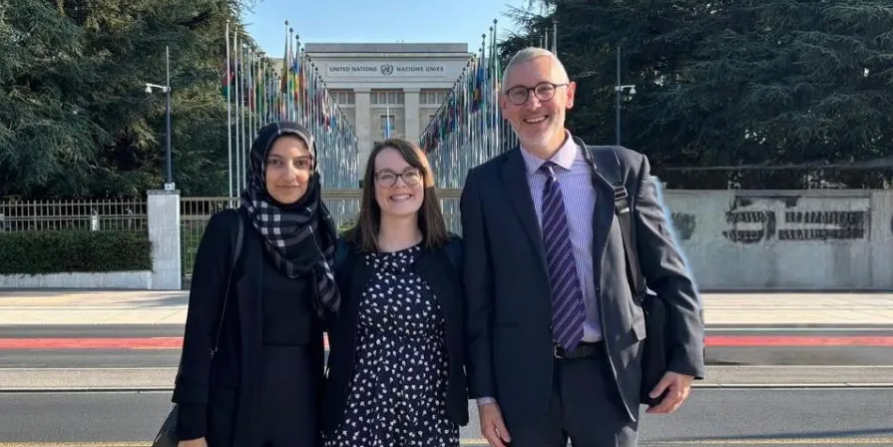
Professor Amna Nazir, Dr Alice Storey and Professor Jon Yorke.
Credit: Birmingham City University.
Web design Adventure
