
Three new stations open on the historic Camp Hill Line, bringing rail services to communities that have been without them since the Second World War
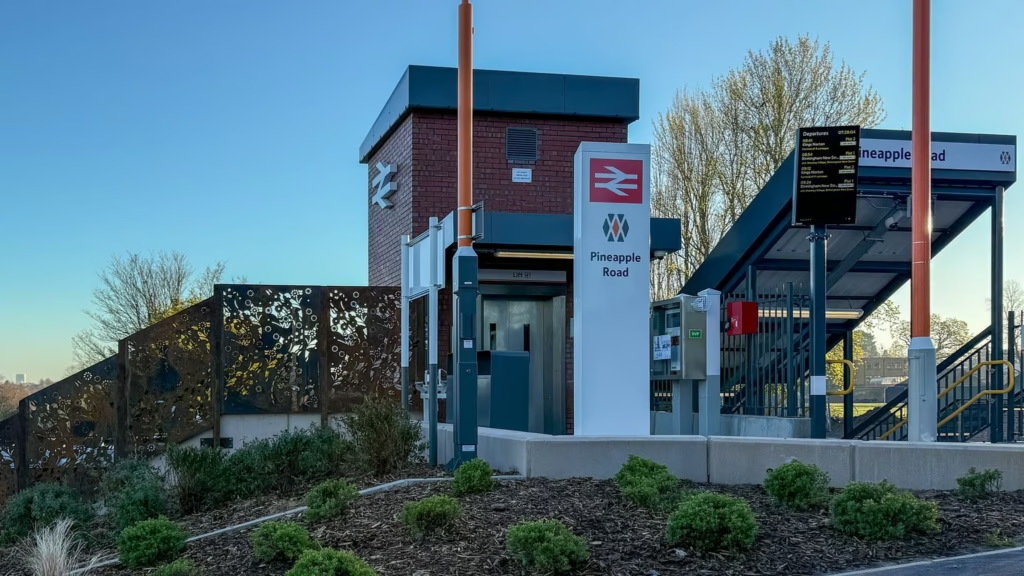
On 7th April 2026, Moseley Village, Kings Heath and Pineapple Road (Strichley) opened to passengers for the first time in over eight decades. Three stations, collectively forming the Camp Hill Lane, restore a direct rail connection between South Birmingham and the city centre — one that was severed in 1941 when the line closed due to coal shortages during the Second World War.
Eighty years in the making
The closure of the Camp Hill Line in 1941 was intended as a wartime measure. In practice, it lasted the best part of a century. For residents of Moseley, Kings Heath and Strichley, the absence of a rail connection has been a persistent feature of daily like — one that has shaped commuting patterns, car dependency and access to the wider transport network for generations.
The fastest journey from Moseley Village to Birmingham New Street now takes around ten minutes. That figure has a particular resonance for communities that have relied on bus routes into the city centre, where journey times are subject to road congestion and can run considerably longer during peak hours.
Partnerships and delivery
The project was led by Transport for West Midlands (TfWM), part of the West Midlands Combined Authority, working alongside the West Midlands Rail Executive, Network Rail, Birmingham City Council, WMR and the Department for Transport.
Sandeep Shingadia, Executive Director of Transport for West Midlands, described the opening as a turning point for three communities that had waited 85 years for a direct rail link to the city centre. Beyond journey times, he pointed to the wider implications for road congestion, carbon emissions and economic development across the region.
Denise Wetton, Network Rail’s Central Route Director, noted the significance of the project within a wider programme of transport improvements across the West Midlands, a programme she described as designed to build a network that better supports passengers both now and in the future.
What It means for South Birmingham
The Camp Hill Line reopening sits within a broader context of transport investment in the West Midlands, but it carries particular weight for the communities it serves. Moseley, Kings Heath and Strichley are among the more densely populated residential neighbourhoods in South Birmingham, with significant numbers of people travelling into the city centre for work, education and daily life.
The new stations do not resolve every transport challenge facing South Birmingham — road congestion, bus frequency and cycling infrastructure remain ongoing issues for residents and campaigners. But the return of rail services is a change of a different order of magnitude. It restores an option that was taken away in wartime and never returned.
Connecting to Birmingham’s wider ambitions
For Birmingham City Council and the West Midlands Combined Authority, the Camp Hill Line is one piece of a larger picture. The West Midlands has been working to expand and integrate its transport network for a number of years, with projects ranging from the Sprint rapid transit routes to the ongoing development of the rail network across the region.
Rail connectivity has long been identified as a factor in economic development, skills access and the levelling of opportunity between different parts of a city. The return of passenger services to the Camp Hill Kine brings three South Birmingham communities into closer reach of the opportunities (employment, education, cultural and civic) that the city centre offers.
WMR Customer Experience Director Jonny Wiseman said the opening marks the return of rail services to local communities for the first time in 80 years, and that the connection between Moseley and New Street in under ten minutes would represent a change for residents whether they are commuting, visiting family and friends, or travelling for leisure.
Web design Adventure
